I’ve been sitting with an uncomfortable question lately: when did we stop talking about food as something to love, and start talking about it as a problem to solve?
I saw it crystallize at the Restaurants Canada Show this year — booth after booth, product after product, each one promising something cleaner, leaner, healthier, or more efficient than what came before. Zero alcohol. GLP-1 friendly. Cell-based. Lab grown. Extra protein. Functional ingredients engineered for performance. Every booth at the show promised something cleaner, leaner, healthier, or more efficient than what came before.
The language of optimization had colonized the language of food.
The Age of Optimization
The shift has been gradual, and it’s come from everywhere at once. On one side, there’s the wellness industrial complex — macros, metabolic health, glucose tracking, longevity optimization, biohacking. On another, the environmental imperative: the meat industry’s carbon footprint, food waste, the ethics of factory farming. Then there’s the convenience economy, accelerated by a pandemic that untethered us from dining rooms and reinforced the idea that eating is, fundamentally, a problem to be solved.
The Ozempic Effect
Now add GLP-1 drugs like Ozempic and Wegovy into the mix. These drugs are not just changing what people eat. They’re changing whether people want to eat at all. Millions are experiencing a pharmaceutical suppression of appetite so complete it extends beyond hunger — past cravings, past desire, into the sensory pull of a good meal itself. Some describe losing interest not just in overeating, but in the sensory pull of a good meal entirely. The craving for your grandmother’s pasta, the anticipation of a birthday cake, the pleasure of a long Friday dinner — muted. Managed. Optimized away.
To be clear: these drugs are helping people with serious health challenges. That’s real and it matters. But we should be honest about what else is happening. We are, for the first time, pharmacologically altering the desire to eat — and doing so at scale, in a culture that was already struggling to remember why food is worth wanting.
“We are, for the first time, pharmacologically altering the desire to eat — at scale, in a culture that was already struggling to remember why food is worth wanting.”
Food That Has Never Touched the Earth
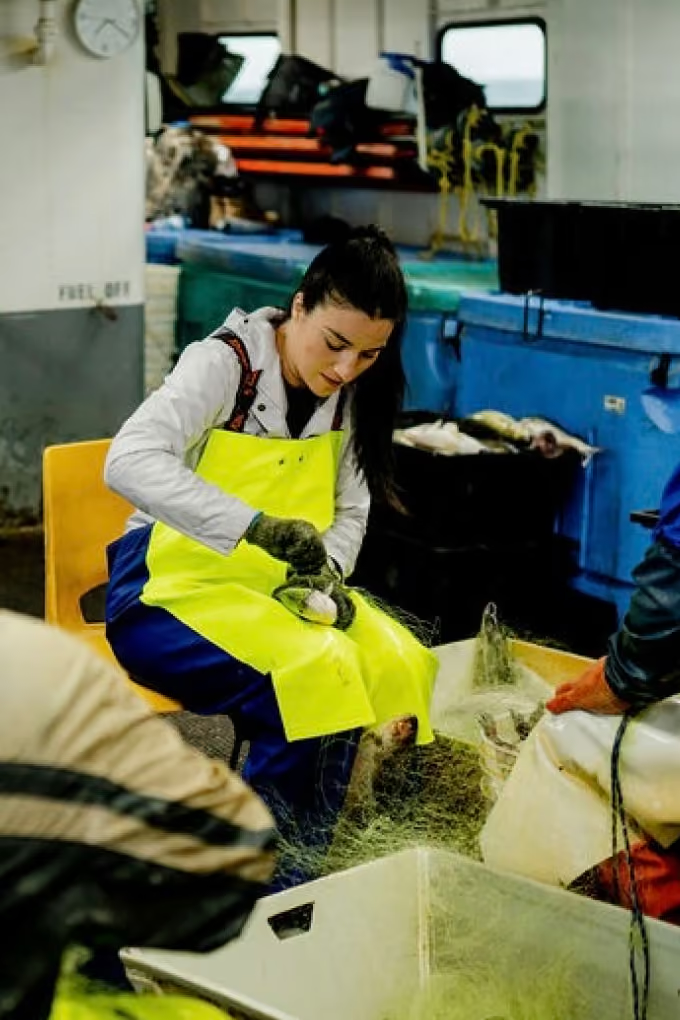
At the world’s largest seafood industry tradeshow last month, cell-based seafood made its debut — protein cultivated in a bioreactor, engineered to replicate the nutritional profile of fish that was never caught, never swam, never existed in an ocean.
I want to be careful here, because I’m not anti-innovation. The food system has genuine, urgent problems — industrial animal agriculture is one of the leading contributors to greenhouse gas emissions, biodiversity loss, and antibiotic resistance. We need new approaches.
From a pure efficiency standpoint, the case for cell-based meat is compelling: lower emissions, no bycatch, no fishing communities gutted by climate change and industrial competition.
But I find the conversation around cell-based meat, lab-grown seafood, and ultra-processed “functional foods” tends to skip a question that matters enormously: who gets to decide what food means?
A bioreactor has no terroir. It has no season, no fisherman who learned the water from his father. When a startup engineers a product that replicates the protein profile of a salmon fillet but has never touched an ocean, what exactly are we valuing? If the answer is purely efficiency and sustainability metrics, that’s a defensible position. But if we also care about the fishing communities, the coastal cuisines, the cultural practices built around catching and preparing and sharing that fish — then efficiency alone isn’t the whole answer.
The food industry is very good at solving nutrition problems. It is much less practiced at asking what gets lost when the solution is purely technical. What about the people at the heart of what we’re trying to “solve”?
The Sobriety of It All
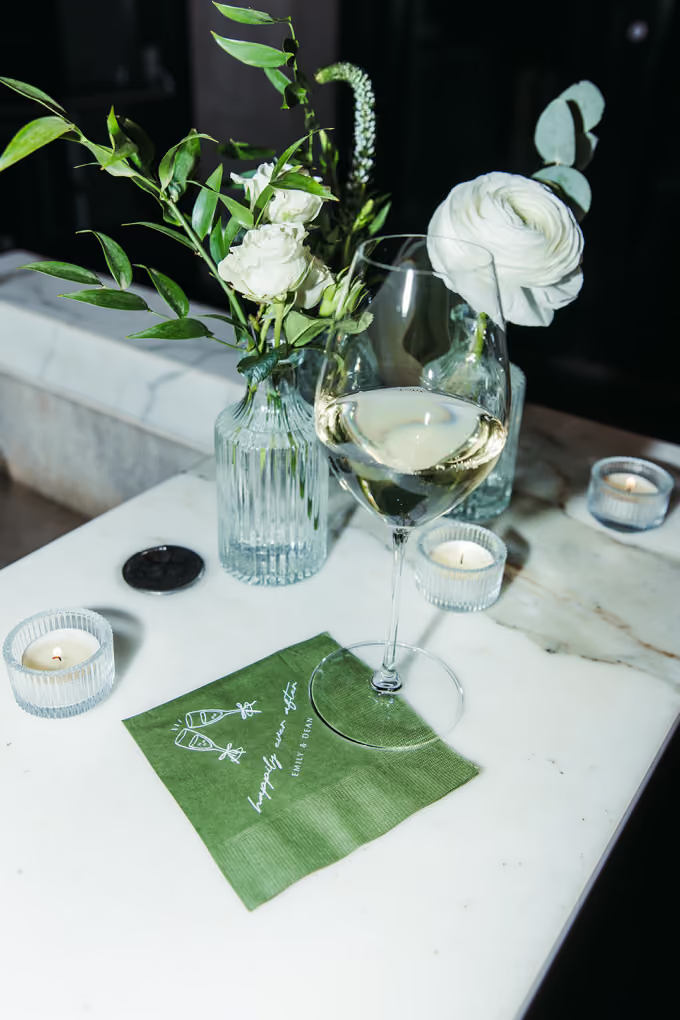
Zero-alcohol products have gone from a niche category to an expectation. Every bar menu now has a mocktail section. Every event planner accounts for the sober guests. Every beverage brand is rushing out an alcohol-free line. And I understand the appeal — hangovers suck, the health concerns are real, and the reasons people choose not to drink are as varied and valid as the people themselves.
But I fear far too many jumped onto the sober curious bandwagon before looking at the facts. Humans have been fermenting grapes since at least 6,000 BCE . Evidence of winemaking has been traced to Neolithic Georgia, ancient Iran, Egypt, Greece, and Rome. Every advanced civilization in antiquity had a deity devoted to wine. Wine was woven into trade, religion, ceremony, and daily life for eight thousand years before anyone thought to make it optional. It didn't become central to human culture because people liked getting drunk. It became central because drinking together is one of the oldest social technologies we have.
Which makes the data on young people and alcohol more complicated than the wellness narrative lets on. Yes, Gen Z is drinking less. But they are also socializing significantly less — time spent in person with friends for those aged 15 to 24 has dropped by nearly 70% over two decades, a decline so sharp the U.S. Surgeon General declared loneliness a public health epidemic in 2023. Their office found that social isolation carries health risks comparable to smoking 15 cigarettes a day — a 29% increased risk of premature death, higher rates of heart disease, stroke, and dementia. We are so focused on what alcohol costs us that we have barely begun to reckon with what its absence, alongside the collapse of the social rituals it anchored, might be costing us instead.
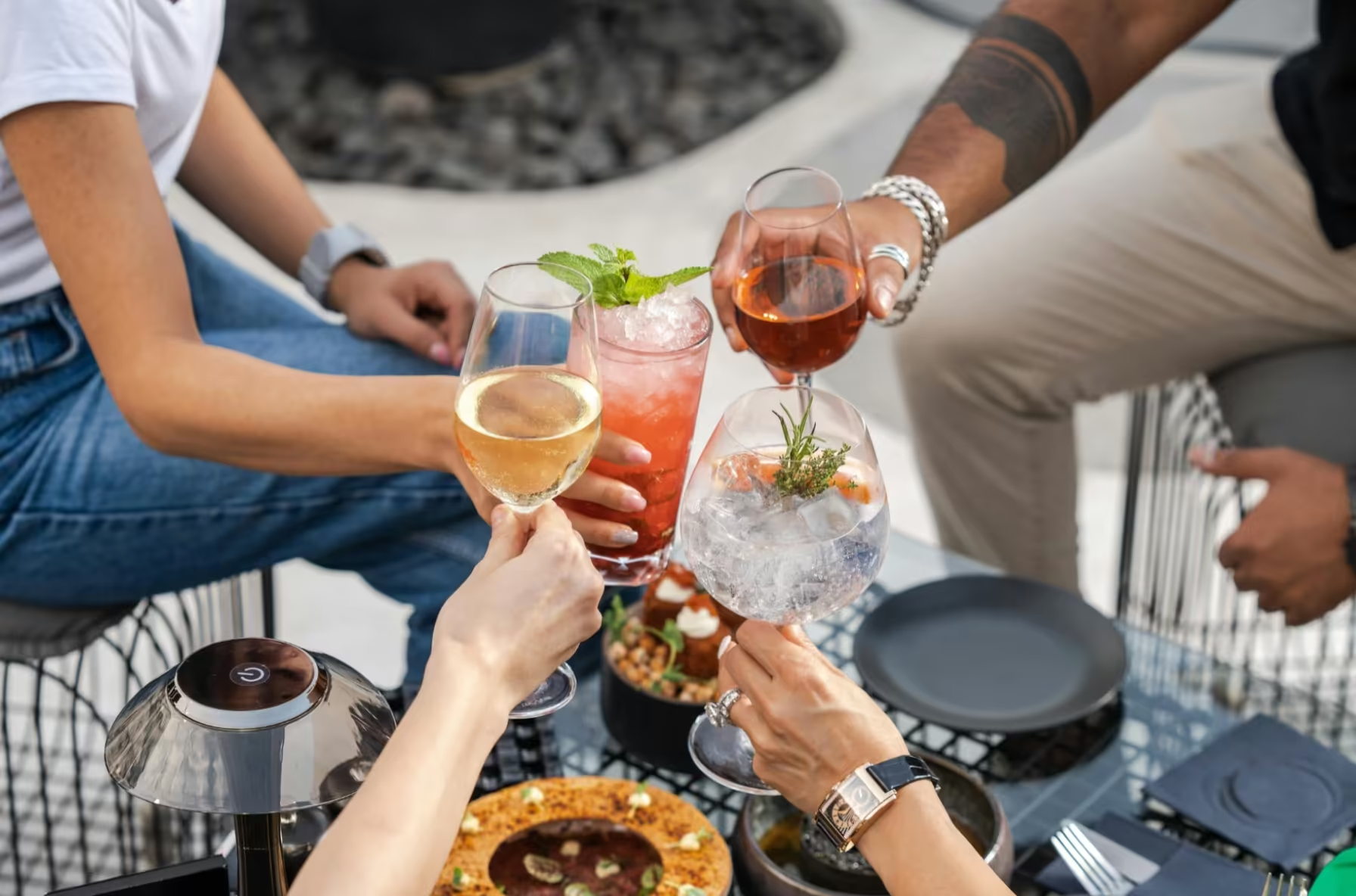
Drinking, for most of human history, has never just been about the alcohol. It's been about rituals that mark the end of a workday or the beginning of a celebration. About the particular loosening that happens over a shared bottle — the conversation that goes somewhere it wouldn't have gone otherwise. When we strip that out in the name of wellness, what are we replacing it with? And is the replacement actually carrying the same weight?
The TikTok Cure for Appetite
And on TikTok, a sentiment that would have seemed dystopian ten years ago is going quietly viral: the idea that food is an inconvenience. “Eating is a chore,” people say, half-joking and half-serious. “If I could just inject myself with nutrients so I don’t have to eat food, I would.” And the comment section is overwhelmingly in agreement. People are foaming at the mouth for a “cure” to eating - they don’t want to waste money or brainpower on thinking about what to eat.
People aren’t just tired of cooking. They’re tired of wanting food. They want the nutritional outcome without the experience. The fuel without the ritual. A cure for appetite.
Somewhere along the way, we stopped talking about food as something we loved and started talking about it as something we optimized.
What We’re Optimizing Away
Here’s the thing about food: it is one of the few remaining spaces in modern life that is fundamentally human. It is inextricably bound to memory, to place, to season, to the people who raised you and the people sitting across from you.
No one fell in love with food because it hit their macros.
They fell in love with food at a street stall in a city they were visiting for the first time. At a family dinner that stretched hours past what anyone planned. Over a bottle of wine that was absolutely not the “healthy choice.” At a counter in their grandmother’s kitchen, watching something transform under heat and hands that knew what they were doing.
Here’s what the optimization conversation keeps leaving out: eating in community is one of the strongest predictors of psychological wellbeing across cultures. The Mediterranean diet, so often cited for its health benefits, isn’t just olive oil and vegetables. It’s a relationship with food that centers pleasure, slowness, and togetherness. You cannot extract the health outcomes from the cultural context and expect them to survive.
Joy isn’t a nice-to-have. It’s not a relic of a more leisurely era or an indulgence the health-conscious can afford to set aside. It’s load-bearing. Strip it out and you don’t have a better food system. You have a different kind of broken one.
“Strip out the joy and you don’t have a better food system. You have a different kind of broken one.”
Flavour is culture. Recipes are memory. The table is where we negotiate who we are to each other. When we reduce meals to macros and ingredients to inputs, we don’t just lose taste. We lose story. We lose the Sicilian grandmother’s ragù that takes four hours and can’t be replicated in a lab. We lose the Indigenous harvest ceremony that’s also a lesson in ecology. We lose the immigrant community that rebuilt itself, partly, through the food it kept making even when everything else had to change.
Where Has the Joy Gone?
The most meaningful food moments of my life were not optimized.
My mom frying fish fillets on Christmas morning — a tradition passed down from her moth and her mother’s mother before that. The smell of it pulled me out of bed before anything else. No recipe written anywhere. It existed in her hands, in the heat of that pan, in a hundred small decisions made without thinking.
My cousins and I, elbow-deep in garlic shrimp late into an evening that kept refusing to end — shells piling up, dirty hands reaching for beer bottles, conversations spilling into each other, nobody wanting to be the first to leave.
My grandmother kneading Portuguese sweet bread for what felt like hours, arms moving in that slow, unhurried rhythm I now understand was not just technique but ritual — insisting that the magic ingredient, the thing that made the bread rise, was a prayer to God. (Admittedly, I’m agnostic. But I have never been brave enough to skip this step of the recipe.)
None of those moments were efficient, but all of them were essential.
That’s not nostalgia talking. That’s an argument about what food is for.
The Standard Worth Holding
None of this is an argument for the status quo. The food system needs to change. It needs to be more sustainable, more equitable, more honest about what it costs the planet. GLP-1 drugs are genuinely helping people with serious health challenges. Cell-based proteins may reduce suffering embedded in industrial animal agriculture. These are real goods.
But the framing of innovation and soul as opposing forces is a false choice. The most compelling food futures I’ve seen — at chefs’ tables, at farmers’ markets, in community kitchens, in the work of people reimagining traditional food systems with contemporary tools — hold both things at once. They innovate without flattening. They improve without erasing.
That’s the standard worth holding the industry to. Not: is this efficient? But: does this still feel like food? Does it still have a story? Does it still do what food, at its best, has always done — bring people together, carry meaning, and remind us what it is to be alive and hungry and here?
The future of food doesn't have to be joyless. But joy won't survive by accident. Someone has to fight for it.