Preface
I recently embarked on what I consider to be one of my most transformative travel experiences to date. I spent just under a week on the Hawaiian island of Molokai, and more importantly, I spent a day touring Kalaupapa, Hawaii’s leprosy colony.
If you follow me on Twitter, you may already know this, as I attempted to disentangle some of my thoughts there initially and share some of my experience at the settlement.
I knew that this was going to be a difficult post to write. It was going to take a while before I drafted something that I felt both appropriately represented the horrors that occurred here, while highlighting its historical significance and honouring the Hawaiian culture.
Writing anything about Molokai has proven to be incredibly difficult. Molokai is a very special island that wants to remain unchanged. The locals there have a saying:
Don’t come to change Molokai, let Molokai change you.
Anybody who writes about Molokai or shares their experience with a wide audience as I am, runs the risk of unintentionally inviting unwanted visitors to the island: visitors who want to change Molokai. But, by keeping my experience on the island to myself, I feel that I am also doing a disservice to those who could benefit from the stories that this magical island has to offer.
At the end of the day, I am a storyteller. It is my job to share these stories, but to do so in a way that is honest, respectful, and sensitive to Hawaii's culture and Molokai residents. I know that many people may never have the chance to visit Kalaupapa and those who can't visit themselves should still have the opportunity to understand and appreciate this important piece of Hawaiian history.
I am prefacing all of my Molokai posts with this information to be supportive of Molokai residents' desire to preserve the island's culture. Before you continue reading, I ask you to keep this in mind. Do not come to change Molokai.
If you're ready to open your hearts and minds to the island of Molokai, to understand its important place in Hawaiian culture and honor its rich history, then I hope you enjoy this post, as well as my other stories from Molokai.
This post highlights some of the history of Kalaupapa, Molokai's leprosy colony, and is a reflection of my thoughts and experiences during my visit.
History of Exile in Hawaii
Beginning in the 1830’s, leprosy spread rapidly through the native Hawaiian population, causing alarm and panic.
Early myths about the disease associated it with biblical references; it was thought to be a punishment from God for immoral behaviour and sexual promiscuity. People hated and feared those whose bodies were marked by the disease and a result, leprosy patients were, and still often are, stigmatized and shunned by mainstream society.
For years, the disease was long feared to be highly contagious. Leprosy causes skin sores, nerve damage, and muscle weakness—symptoms that become debilitating if left unaddressed but are now treatable with antibiotics.
In response to growing concerns about the spreading of the disease, in 1865, King Kamehameha V signed into law “An Act to Prevent the Spread of Leprosy” which allowed for the exile of all people with leprosy to Kalaupapa, an isolated peninsula on the island of Molokai.
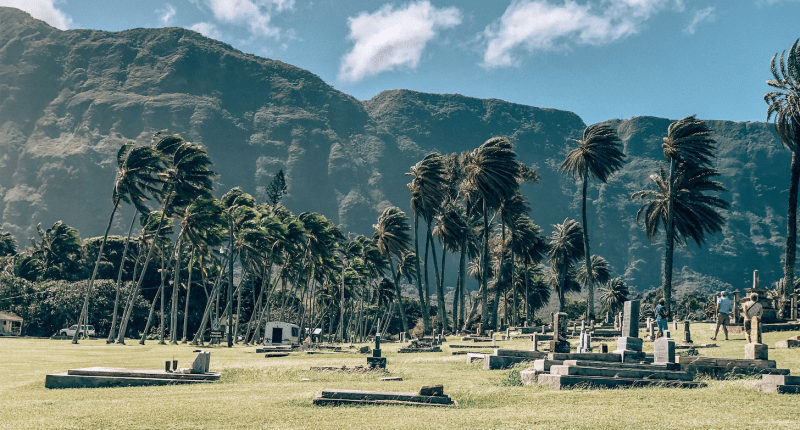
Segregated from the rest of the island by some of the tallest sea cliffs in the world and surrounded by the ocean on the other sides, the isolated peninsula was the perfect place for banishment.
On January 6, 1866 the first group of, 12 patients, arrived at the settlement for isolation.
11 of them died within the first five years in exile.
Kalawao, on the east side of the peninsula, was the site of the initial leper settlement. The cone-shaped island offshore is where early sea captains with boatloads of new patients would anchor, as rough seas often made it impossible to get any closer to shore. Frightened passengers were then forced to jump overboard and swim for shore in rough seas. Many of them never made it and drowned.
There was little in the way of infrastructure and resources when the first patients arrived. It was believed the patients would be able to support themselves by raising animals, farming, fishing, and living the subsistence lifestyle. What wasn’t accounted for was the effects of the inhospitable cold and damp Kalawao climate, which contributed to the patients’ decline and their inability to participate in any day-to-day tasks.
The early years of the settlement brought chaos, confusion, and conflict. More patients began to arrive but weren’t being given food provisions from the Board of Health. The only food available to new patients was the food shared by existing patients and often food shortages caused disputes among patients. Soon, there also weren’t enough homes in the settlement, causing more conflict among the patients.
As time passed, conditions gradually improved due to patients demanding more respectable living situations and a few key champions advocating the Board of Health on their behalf. Eventually, the settlement was moved from Kalawao to Kalaupapa, where the conditions were more favorable. The patients of Kalaupapa began to form a community of sorts – they planted, rationed food, socialized, fell in love, got married, and had babies.
Almost all women in the settlement gave birth at one point, but due to the fear of contagion, newborns were immediately removed from the care of their mothers and put up for adoption. The Board of Health made all efforts to erase any trace of the child’s true lineage as leprosy stigmas would result in the child not being adopted. Many children born in Kalaupapa grew up never knowing where they came from or who their parents were.
Alongside the tragedy of Kalaupapa were stories of incredible courage and sacrifice.
In 1873, Father Damien, a 33-year-old Catholic priest arrived in the settlement determined to improve the lives of the sick and save their souls for Christ, constructing sturdy buildings and, sometimes daily, helping build their coffins and dig their graves. From the very first day he arrived, Father Damien broke all the rules of engagement, regularly touching patients and sometimes even eating from the same dishes as them. He never saw them as “lepers” but as friends.
After he contracted leprosy, Father Damien wrote that he was now "the happiest missionary in the world." He died in the settlement 1889 at the age of 49.
As the population in the settlement grew, there was a growing need for nurses to care for female children, women, the elderly, and the bedridden. Before Father Damien passed, he wrote to over fifty different sisterhoods requesting help in Kalaupapa. Only one answered the call.
Mother Marianne Cope, another beacon of hope for Kalaupapa patients, arrived in the settlement in 1888.
She is credited for strengthening the community in the settlement and working tirelessly to make it a more beautiful place for patients. In addition to looking over all of the women and girls, Mother Marianne raised money to start programs that gave patients a more dignified life. She developed classes to allow young girls to continue their education. She provided religious counseling and tried to beautify the landscape by planting gardens.
Mother Marianne worked in the settlement for 30 years. She died of natural causes in 1918. Neither her nor any of the sisters ever contracted leprosy during their time in the settlement.
Both Father Damien and Mother Marianne were both canonized as saints. Kalaupapa remains the only place in the world where two saints worked and died.
The End of Exile
Over the years, more than 8,000 exiles would die in Kalaupapa, many disfigured, crippled and blinded by the sickness. At its peak, the settlement had more than 1,200 residents: men, women and children.
In 1946, sulfone drugs were introduced for long-term care of leprosy patients. Leprosy should have been less scary since effective treatment made patients no longer contagious. Yet, it wasn’t until 1969, more than 20 years after the treatment had been introduced, that the official isolation policy ended in Hawaii.
104 years after banishment began, the exile law was finally lifted.
Despite this new freedom, the social stigma associated with leprosy continued, and many patients felt shunned by their communities even after their treatments were complete. Despite the new treatment for leprosy, the stigmatization of the disease continued. Those who did leave found it difficult to accomplish basic tasks like get a job and rent an apartment because as soon as people found out you were from Kalaupapa, they didn’t want to be anywhere near you. For many patients, Kalaupapa was the only home they knew after being exiled as young children and spending decades in isolation.
Though they were now free to leave, most have stayed and lived out their days here.
Kalaupapa Today
Today, leprosy is better understood, we know that it doesn't spread easily, and it can be treated with antibiotics.
In 1980, the colony was turned into a National Historical Park, now known as Kalaupapa National Historic Park. Kalaupapa is no longer a prison for those afflicted by leprosy, but now serves as a refuge for the remaining patients of the settlement.
As of February 2020, five patients remain in Kalaupapa; the youngest is 79 and the oldest is 96.
The Hawaii Department of Health administers the site with a group of approximately 75 state and federal workers, including nurses, maintenance people, police, firefighters, and National Park Service employees. Workers live in the settlement five days a week and fly home on the weekends.
The Future of Kalaupapa
The future of Kalaupapa has become a recent discussion in Hawaii. As only five patients remain in the colony, it embarks the question: what will happen when the last patient dies?
The only certainty at this point, is that once the final patient dies, the state will leave, and the National Park Service, who’s intentions with the settlement remain largely undecided, will take over Kalaupapa.
According to a 2015 report, the “preferred” proposal of the National Park Service would fully open Kalaupapa up to tourists. This preferred proposal has caused significant concern among Native Hawaiians and Molokai residents who fear that the days of Kalaupapa as they know it are numbered. This debate is further exacerbating political and cultural tensions in Hawaii, deepening the divide between locals and outsiders to the islands.
The non-profit organization Ka 'Ohana O Kalaupapa, made up of remaining patients and non-patients with ties to the settlement are fighting tirelessly to make sure authorities “leave Kalaupapa as Kalaupapa”. The organization is dedicated to promoting the value and dignity of every individual exiled to Kalaupapa and hope to serve as a resource for decision-makers to preserve, protect and perpetuate the history, the way of life, the values, the cultural heritage and the environment.
During my visit to the settlement, our tour guide seemed to recognize that change would be inevitable once patients are gone, as many of the laws and restrictions in place in the settlement only exist to protect patients. Once they are gone, there will no longer be a need for them. While our guide believed many of the restrictions would be lifted, he was confident the settlement would remain a protected national park, sheltered from any further development.
While the future of the settlement remains in the limbo, the five remaining patients are safeguarding it for the time being. Once they are gone, there is no doubt in my mind that the spirited people of Molokai and Hawaii will do everything to make sure that this sacred land is protected and those who were exiled are never forgotten.
If you are interested in supporting the efforts of Ka ‘Ohana O Kalaupapa, you can DONATE HERE.
Planning Your Visit to Kalaupapa
I won’t go in to too many details about the logistics of how to get to Kalaupapa. Most of this information is available on the National Park website.
Only 100 outside visitors are allowed into the park each day. If you wish to visit, you need to plan well in advance as you’ll need to obtain a permit, which most tourists do by booking directly through a tour company. It is ILLEGAL to enter Kalaupapa without a permit.
As of February 2020, the Kalaupapa Trail remains closed indefinitely due to a landslide, meaning Kalaupapa is only accessible via aircraft at this time.
*UPDATE: Due to the COVID-19 pandemic, the park is currentlyclosed to outside visitors.
Why You Should Visit
One of the main reasons that I travel is to experience other cultures and learn about their history. As a traveler and as a human being, I felt a responsibility to understand this story and share it to keep the memory of those we lost alive.
As someone with a deep, deep love for the Hawaiian Islands, it is heartbreaking that this piece of its history is so hidden from plain sight. Most tourists to the islands will drink their Mai Tai’s on Waikiki Beach, oblivious to the horrors that occurred just 85 kilometres away.
Travel is supposed to open your mind and widen your perspective; in Hawaii, Kalaupapa is the place to do that. If you’re truly looking to learn about and honour Hawaiian culture, then you need to visit Molokai and Kalaupapa.
Further Reading
Through this article, I have aimed to provide a high-level overview of what I think are some of the most important pieces of Kalaupapa’s history, but it by no means represents the entirety of its story.
Whether you plan to visit Kalaupapa or not, I highly recommend take some time to learn more about the history of this sacred place. Reading some of these books are what inspired me to visit Kalaupapa in the first place and having a bit of prior knowledge made my time in Kalaupapa that much more impactful, as I was able to see and experience the places I’d only read about in books and better understand the atrocities of each space.
- The Colony – John Tayman
- Molokai – Alan Brennert
- The Separating Sickness – Ted Gugelyk and Milton Bloombaum
Need a place to stay on Molokai? Check out my review of Hotel Molokai.
Sources:

.jpg)